The only airplane on the airport of Narvik was a military transporter.
Lured by the Aurora Borealis, we travelled to the frigid Arctic Norway and Sweden. We arrived at the small joint military and public airport of Narvik, a town with 15.000 inhabitants, 400 km north of the Arctic Circle. As soon as we deboarded, we quickly put on our thermal clothing to protect us against the fridged wind.
Narvik is a compact and walkable city. The houses are timber framed for insulation and look minimalistic, tidy, and clean. Rugged mountains and fjords dominate the town. The people were celebrating the ‘Vinterfestuka' festival, welcoming the spring season with the daylight hours rapidly increasing. The women dressed in traditional black long skirts, blouses and shawls and men with black vests, dark trousers and wide-brimmed hats decorated with commemorative pins. In the few restaurants and bars live music lifted the spirits of the people after a long and dark winter. In a festive tent specially built for this occasion a friendly man welcomed us: ‘Where are you from? Join us for some drinks’.
Keeping warm in the afternoon sun.
The ski slopes with the town of Narvik down at the Rombaksfjord in the far distance.
The port of Narvik with the iron ore terminal in the background.
The year-round ice-free port is dominated by an iron ore terminal. The next couple of days we followed this iron ore to its source: the LKAB mine in Kiruna, Sweden. Francien and I boarded the passenger train to Kiruna. Steadily the train climbed the mountains, skirting along deep fjords. We reached the highest point 500 meters above sea level at the Swedish border. On route, the train stopped a few times at some huts in the middle of no-where, dropping off backpackers carrying their skies and sledges. It is a single track. A few times our train waited to let ore trains pass. The lakes in Sweden were all frozen. At one point our train abruptly slowed down to avoid hitting crossing reindeers.
Our train halted to wait for the ore train to pass.
In three hours, we travelled 180 km from the salty Norwegian Rombaksfjord to the frozen tundra. We crossed tunnels, narrow bridges, underneath snowsheds, along deep ravines. All in this white wilderness.
When we arrived in Kiruna, we visited this biggest and most modern underground iron mine in the world. The tunnelling system was so big, we drove with a 50-passenger tour bus down to its visitor centre 500 meters below the surface. Mining operations are largely remotely controlled from a control room above ground. Even down there, we had excellent mobile phone and internet connections. We saw the equipment’s to drill blastholes, skiffs, loaders and crushers.
Drilling machine 500 meters below.
Undergound ore crusher.
Underground earth moving machine.
The town had a bland appearance. But the people were friendly, helpful. A bus driver didn’t want us to pay as a he saw we were foreign visitors. We enjoyed the food: reindeer souvas (salted, dried and smoked meat), lingonberries, bosnafish and halibut.
People used cars, snowmobiles, skies, sometimes huskies pulling sleds. Car tires made squeaking noises, because of the spikes embedded in the treads. All roads and walkways were covered with crushed gravel. We saw snowmobile tracks instead of bicycle tracks!
Kiruna exists solely because of the ore beneath it. Life resolves around the mine, most people working 3 weeks on, 1 week off, many lured by the high wages. It makes for a close-knit community.
At night 01:30 we woke up as the ground subtly vibrated and we heard the sounds of underground blastings 1300 meters below.
The ore body dips under the city, causing massive ground deformations like the sinkhole we saw, hundreds of meters long. This causes houses to collapse and even the railway station we arrived on was a temporary construction. We saw works to demolish those houses and build new ones, apartments, roads and future commercial buildings. Yes, the city is sinking and 40% of Kiruna’s 20.000 population is moving to a safer place.
One evening we walked on the frozen Thon River looking for Aurora Boleares in the clear sky. The air felt crisp and dry. It was peaceful and yet hostile as we were amid unforgiving fridged nature. We saw ‘weak’ Polar Lights as stripes and sheets with a faint light green hush moving gently sky. Alas, they turned out to be little more than greenish smudges of light curtains. Only when we used our camera, more colours were visible, because the camera lens is more sensitive than the human eye.
The Northern Lights.
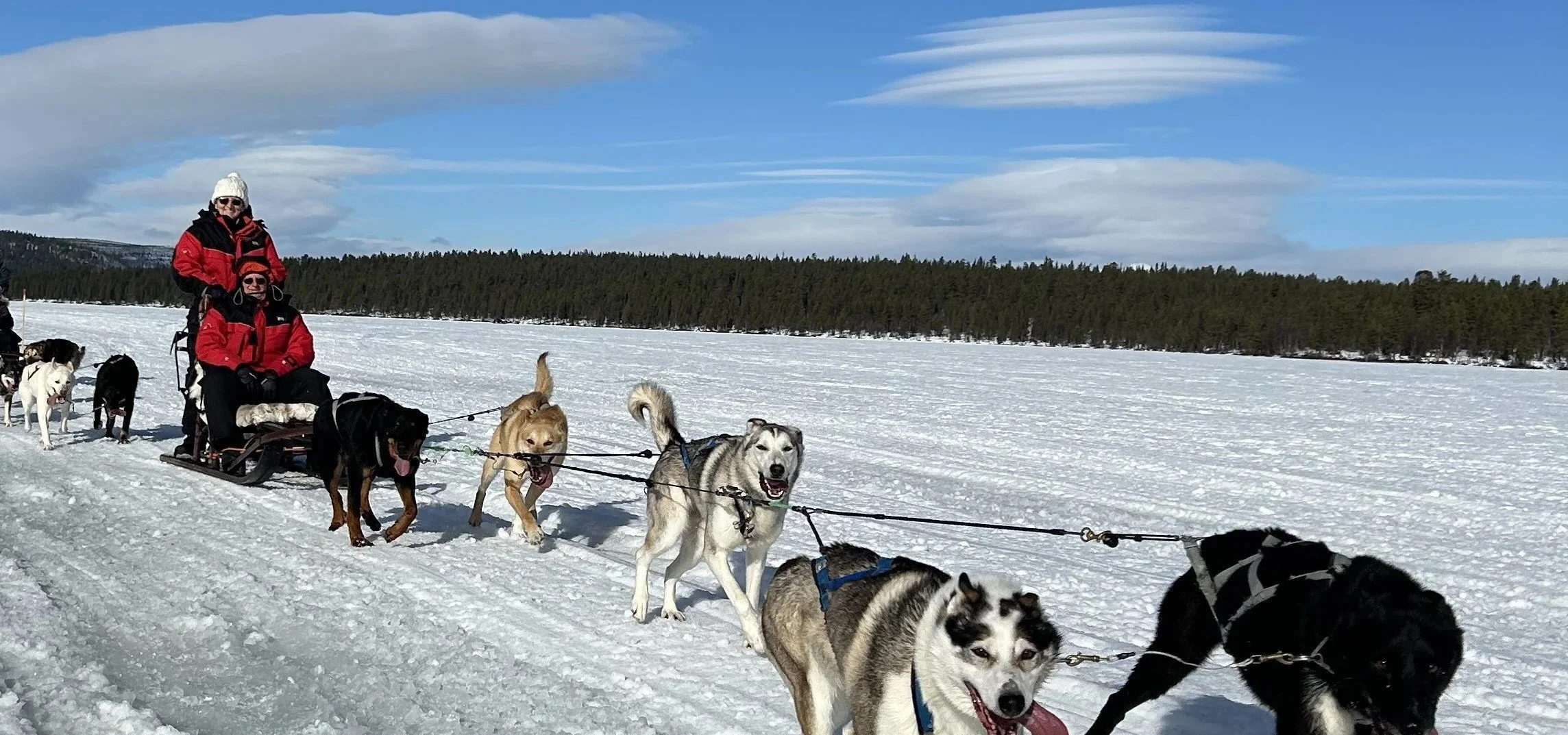
The stillness of strolling across the frozen Thon River contrasted to the adrenaline rush of driving a dog sled. Even before we saw the sleds, we heard 35 Alaskan huskies in an explosion of sound – high pitched yaps and deep howls. The dogs were not just excited; they were desperate to run. Francien and I swapped being the musher on our sled, standing with both feet on the brake to control the speed of the dogs. The moment we released the brake, the barking stopped and all we heard was the huff- huff- huff of our five dogs and the dry shush of the wooden runners. On the sled we travelled 20 km through tundra, boreal and birch forests. Crossing a frozen lake gave a sense of freedom and peacefulness. During a 30-minute Fika stop we played with the dogs, affectionate companions of the guides. Mushering Alaskan Huskies was an entirely new experience. It was amazing to see how five dogs pulled our sledge up a hill, across ice and fresh snow. We stopped three times to untangle one of the dogs. We left the sled with a face that felt wind burnt and glowing, the true sense of the far North.
Our guide Asa explained: ’10 Years ago changed my past city life for this remote wilderness lifestyle and never regretted.’ Made me think!
Mushering our sled across a frozen lake.
Enjoying a Fika, Swedish coffee break, and warming up with some extra hot soup.
Our dogs ran 15 Km/hr.
With one of the Alaskan Huskies.
And yes, Francien and I did sleep one night in the Ice Hotel. It is entirely built from ice, harvested as massive blocks weighing each 2 tons from the nearby Thon River. A thick layer of snow acts as an insulator. We slept in a room with ice sculptures, on an ice bed covered with reindeer hide. Our luggage was kept in a separate heated building with showers and bathrooms. We walked through the fridged cold ( -5 C) hotel wearing only one layer of thermal underwear, before we could wrap ourselves in an expedition sleeping bag. Inside the hotel it was very quiet, the thick walls of ice dampened all sounds. The air on our faces was crisp, but the rest of our bodies stayed warm. We slept surprisingly well and, in the morning, we woken up with a hot lingonberry juice. A surreal experience to say the least.
The Ice Hotel is made out of these blocks, cut out from the frozen Thon River.
Piano in the Ice Hotel. Everything is made out of ice!
Frank is checking if the bed will be warm enough.
Nice and ‘warm’ in the sleeping bag on top of the ice bed.
This journey moved us past the surface-level tourists. We came to Lapland to see the Aurora Borealis, and although we saw some, it did not appear like we thought it would. Instead, we experienced this outpost country: it’s slow lifestyle; unforgiving wilderness; the harsh climate, the isolation, the work underground, the long winter nights, even the moving of houses because the ground below is sinking. Life here is a master class in adaptation. When we climbed the airplane stairs, a strong biting wind blew our faces. I did not want to leave Kiruna.